Many moons ago, I wrote on this very blog, a piece called Is There Life After Life which, if you kindly read it, you might remember that I was musing the benefits (or pitfalls) of retraining and starting a new career in later life. Because, let’s be honest, age is creeping up on me like starving bear and I’ll soon be on the adland scrapheap, with a one way ticket to the NABS* Home For the Bewildered. Also, my young dumb self wasn’t overly sensible with the pension pot, having decided to take some of it out to fund my sweet martini addiction, so by now, I could just about have afforded to start that slow descent into coffee mornings and chair yoga. Still, hindsight is a beautiful thing and it’s also a bloody shitter because my delicate shins are now covered in bruises from kicking myself at regular intervals.
I’d always thought of myself as a good listener, as someone with empathy and always willing to pop to the pub and listen to someone’s woes. The idea of becoming a counsellor had been niggling away at me for years but I was in no position, physically or financially, to shell out £27k (thanks, Mr Cameron, you evil piggy fiddler) or spend precious evenings sat in a cold classroom and even more precious weekends with my head in a difficult book. I needed to find something that worked around my hectic schedule of working full time, mothering full time, wife-ing full time and all things in between. So it was with great delight that I eventually stumbled upon a fabulous local training institute that not only offered a mutually suitable training times and a less rigorous approach, it also meant I wouldn’t have sell some of my organs. What’s left of them.
So I bit the bullet signed up. Apart from having done a 101 beginners thing, I really didn’t know what to expect. All I knew was that I was about to spend the next 4 years studying Transactional Analysis. Google it – as I did! It’s nothing to do with analysing my terrible shopping habits as that would take forever. But in a nutshell, it’s a bit of a mish mash of all the counselling modalities – humanistic, person-centred, CBT etc – working mostly on the basis that everyone is OK. It analyses social interactions, or “transactions” (hence the name) to determine the ‘ego state’ of the communicator. There are 3 ego states – child, parent, and adult – the idea being that by applying TA theories, one can help people identify the roles they play in interactions and what they’re really saying. No, I didn’t get it either but everyone seemed very nice.
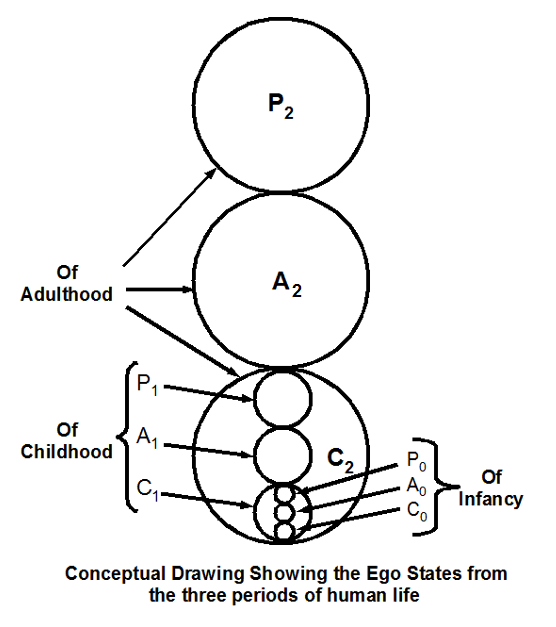
An Ego State Model. Which is nice!
Day one and I rocked up to a room full of around 18 people, from all walks of life, some clearly with experience of this sort of thing and others, like myself, looking a little nervous. It all started very well and I was confident it would be interesting and rewarding and I would learn lots of exciting psychotherapy type stuff, and I certainly did. However, the one thing I didn’t bank on was having to be quite so open in front of a group of people I didn’t know. I’ve generally worked on the basis that no-one really wants to hear my hang ups or issues and I’m a generally a damn good actress if need be. But it became very apparent that, part of the learning process, was to be honest about my own thoughts and feelings, in front of everyone. Things that I’d rather keep in a locked case under the bed thank you very much. And the thought of having to share it all with a bunch of strangers who I didn’t know from Adam or Eve was actually quite terrifying. But as the weeks and months went on, I realised that if I was to learn how to help others, I had to be pretty sure about myself too.
Talking about yourself isn’t really very British, is it. Stiff upper lip, have a nice cup of tea and get on with it has generally been my motto so I was definitely finding this all a bit uncomfortable. But I think what I found more uncomfortable was actually facing some rather unconscious prejudices that I never knew existed. On that very first day of training, I nervously walked into the room and immediately joined a couple of other white, middle-class, middle-aged ladies because, well that’s what I am so there I must go. I’m sure the young asian girl is very nice and the long haired chap isn’t a weirdo but nevertheless, I subconsciously gravitated to what I assumed to be, like-minded, bewildered (well, at least I was) 50-somethings all in search of a plan b.
I grew up in the 70’s. I say East London because it’s an got an E in the postcode but truth be told it’s not exactly all jellied eels and gangland shootings around here and I had a very nice, safe and comfortable upbringing. But nevertheless the changing face of London was very much out there, particularly for my grandparents and their 18 siblings! The east end of London, where most of them lived, had seen an influx of black and Asian families move into the area, driven by factors such as post-war immigration policies, the demand for labour in a recovering economy and the search for better opportunities in the capital. However, my great uncle Fred had a slightly different view. And while it did indeed bring about a rich and dynamic multicultural environment, it also exposed deep social and racial divisions. He thought nothing of hurling abuse at black bus drivers or the Pakistani family that ran the corner shop and I thought, at the young age of about 7 or 8, that this was all normal. TV programmes such as Love Thy Neighbour and Rising Damp all endorsed that it was absolutely acceptable behaviour. With no real authority saying this really isn’t OK, I guess I went along with it.
So there I was, sat in a Alcoholics Anonymous-type circle, with a completely mixed bag of folk, about to actually talk my about thoughts and feelings with a sense of utter dread. Nerves like I hadn’t experienced since my disastrous one line in the school play circa 1971 which saw me banished to the back of the chorus. I certainly wasn’t going to be putting my hand up to go first – in fact, I was mostly the last one – as I had to carefully assessed everyone’s else’s narratives, outpourings and honesty before deciding what to say and what not to say. And I realised that said a lot about who I was. It was an emotional experience. Very emotional. Because ultimately, Psychotherapy is fundamentally about change—helping individuals make meaningful, positive transformations in their thoughts, behaviours, emotions, and overall well-being. And it ain’t easy. If you know you want to make changes, then you’re part of the way there. Often we don’t know we want or need to make changes because we think we’re totally fine. But then you discover, through this journey of self-discovery, that you’re not remotely OK and you’re carrying allsorts of prejudices, emotional baggage, past traumas and uncertainties. And that’s bloody hard.
It was a tough first year, I’ll be honest. I struggled with some of the theories, I felt uncomfortable about talking about my feelings and even more uncomfortable hearing some of my fellow students stories – especially that young Asian girl whose parents showed her no love or support and another, whose tardiness I found irritating, turned out to be crippled with constant panic attacks. Others had encountered huge loss or were living with health issues but somehow we all bonded and by the time our first year finished, I loved each and everyone of them. For my final year 1 presentation, I wrote a letter to my younger self, which was a basically a run down of regrets and hope for my future. Everyone cried. My tutor cried. I cried. And that doesn’t happen often.
Not many went on to do the full training but we all stay in touch. And the honest truth is that rest of the course wasn’t easy at all, especially the covid years and training online. I missed the physical stuff, the hugs in the tea break and the warmth in the room but I made it through the 4 years and completed the course. I did a placement where I saw around 10 clients over 2 years and clocked up my 100 hours, allowing me to practise. And I have 3 clients from that time that I still see today. It’s a wonderful thing – a privilege actually – to be trusted with someone’s transformation and I’m chuffed to bits that I actually did it. I confess, I don’t understand a lot of the theories and I’ve many an unread book on the shelf, but it sure changed me. I’d like to think for the better although I’m not sure Mr H agrees. My wincing at Carry On films, especially the treatment of women and ethnic minorities now classes me as a bit self-righteous, but I’d say I’m just more aware. More aware of others and what I don’t know and more aware of myself and what I do know. And learning to be kind to others as you really don’t know what they might be going through. Sounds like an over-used cliché these days but it’s real.
However, the above does not apply to mosquitos. They can fuck right off!
*NABS – where ex-ad folk go to stare at the seaside view whilst reminiscing about the days when you could smoke at your desk, snort coke off your secretary’s thigh and woke was something you did, on the cold office floor, next to Brian from the post room, the morning after the Christmas party!
 Wife On The Edge